Table Of Content
One concrete application is a microarray study, where several conditions are to be tested, but only two dyes are available for each microarray. If all pairwise contrasts between treatment groups are of equal interest, then a BIBD is a reasonable option, while we might prefer a reference design for comparing conditions against a common control as in Figure 7.11A. When we have missing data, it affects the average of the remaining treatments in a row, i.e., when complete data does not exist for each row - this affects the means. When we have complete data the block effect and the column effects both drop out of the analysis since they are orthogonal.
Functionally analogous body- and animacy-responsive areas are present in the dog (Canis familiaris) and human ... - Nature.com
Functionally analogous body- and animacy-responsive areas are present in the dog (Canis familiaris) and human ....
Posted: Tue, 27 Jun 2023 07:00:00 GMT [source]
Directed Group Study
Consider a factory setting where you are producing a product with 4 operators and 4 machines. Then you can randomly assign the specific operators to a row and the specific machines to a column. The treatment is one of four protocols for producing the product and our interest is in the average time needed to produce each product. If both the machine and the operator have an effect on the time to produce, then by using a Latin Square Design this variation due to machine or operators will be effectively removed from the analysis. For most of our examples, GLM will be a useful tool for analyzing and getting the analysis of variance summary table. Even if you are unsure whether your data are orthogonal, one way to check if you simply made a mistake in entering your data is by checking whether the sequential sums of squares agree with the adjusted sums of squares.
Magnitude of Effects
The ratio of mean squares of treatment over error gives us an F ratio that is equal to 14.44 which is highly significant since it is greater than the .001 percentile of the F distribution with three and nine degrees of freedom. In this experiment, each specimen is called a “block”; thus, we have designed a more homogenous set of experimental units on which to test the tips. In studies involving human subjects, we often use gender and age classes as the blocking factors. We could simply divide our subjects into age classes, however this does not consider gender.
Mean Squares

Typical block factors are location (see example above), day (if an experiment isrun on multiple days), machine operator (if different operators are needed forthe experiment), subjects, etc. Ideally I wouldn’t have to do the averaging over the nested observations and we would like to not have the misleading p-values for the plots. To do this, we only have to specify the nesting of the error terms and R will figure out the appropriate degrees of freedom for the covariates. Because this is an orthogonal design, the sums of squares doesn’t change regardless of which order we add the factors, but if we remove one or two observations, they would.
Each treatment group has eight mice, with half of them female, the other half male. The experiment design looks similar to a factorial design of Chapter 6, but the interpretation of its analysis is rather different. Most importantly, while the factor Sex is fixed with only two possible levels, its levels are not randomly assigned to mice. This is reflected in the fact that Sex groups mice by an intrinsic property and hence belongs to the unit structure. In contrast, levels of Drug are randomly assigned to mice, and Drug therefore belongs to the treatment structure of the experiment.

2 Split-plot designs
Intercontinental Exchange Reports January 2024 Statistics - Business Wire
Intercontinental Exchange Reports January 2024 Statistics.
Posted: Mon, 05 Feb 2024 08:00:00 GMT [source]
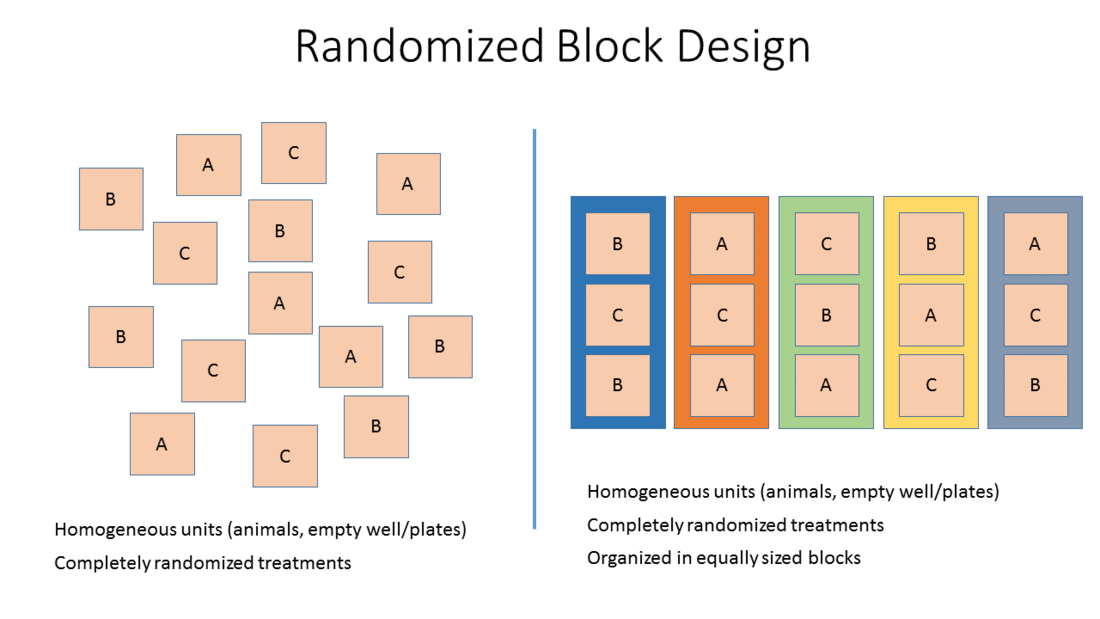
This type of design is called a Randomized Complete Block Design (RCBD) because each block contains all possible levels of the factor of primary interest. We can typically consider the levels of a blocking factor as randomly drawn from a set of potential levels. The blocking factor is then random, and we are not interested in contrasts involving its levels, for example, but rather use the blocking factor to increase precision and power by removing parts of the variation from treatment contrasts. As always, practical considerations should be taken into account when deciding upon blocking and randomization. There is no point in designing an overly complicated blocked experiment that becomes too difficult to implement correctly. On the other hand, there is no harm if we use a blocking factor that turns out to have no or minimal effect on the residual variance.
4.2 Nesting Blocks
Linear mixed models account for all information, and results might differ slightly from an ANOVA if the design is not fully balanced. In addition, the block totals—calculated by adding up all response values in a block—also contain information about contrasts and effects if the block factor is random. We again refrain from discussing the technical details, but provide some intuition for the recovery of inter-block information. Another purpose for using a multi-laboratory experiment is to broaden the inference for our experiment. Note that the least squares means for treatments when using PROC Mixed, correspond to the combined intra- and inter-block estimates of the treatment effects.
The most common blocking design is the randomized complete block design, where each treatment occurs once per block. Its analysis requires the assumption of no block-by-treatment interaction, which the experimenter can ensure by suitable choice of the blocking factor. The efficiency of blocking is evaluated by appropriate effect sizes, such as the proportion of variation attributed to the blocking.
We let the row be the machines, the column be the operator, (just as before) and the Greek letter the day, (you could also think of this as the order in which it was produced). Therefore the Greek letter could serve the multiple purposes as the day effect or the order effect. To conduct this experiment we assign the tips to an experimental unit; that is, to a test specimen (called a coupon), which is a piece of metal on which the tip is tested.
An attractive alternative is the linear mixed model, which explicitly considers the different random factors for estimating variance components and parameters of the linear model in Equation (7.1). Linear mixed models offer a very general and powerful extension to linear regression and analysis of variance, but their general theory and estimation are beyond the scope of this book. For our purposes, we only need a small fraction of their possibilities and we use the lmer() function from package lme4 for all our calculations.
Nesting blocking factors essentially results in replication of (parts of) the design. In contrast, crossing blocking factors allows us to control several sources of variation simultaneously. The most prominent example is the latin square design, which consists of two crossed blocking factors simultaneously crossed with a treatment factor, such that each treatment level occurs once in each level of the two blocking factors.
The independent variable is cell phone use and the dependent variable is driving ability. A potential control variable would be driving experience as it most likely has an effect on driving ability. Driving experience in this case can be used as a blocking variable. We will then divide up the participants into multiple groups or blocks, so that those in each block share similar driving experiences. For example, let's say we decide to place them into three blocks based on driving experience - seasoned; intermediate; inexperienced. The definition and analysis of linear contrasts work exactly as for the two-way ANOVA in Section 6.6, and contrasts are defined on the six treatment group means.




No comments:
Post a Comment